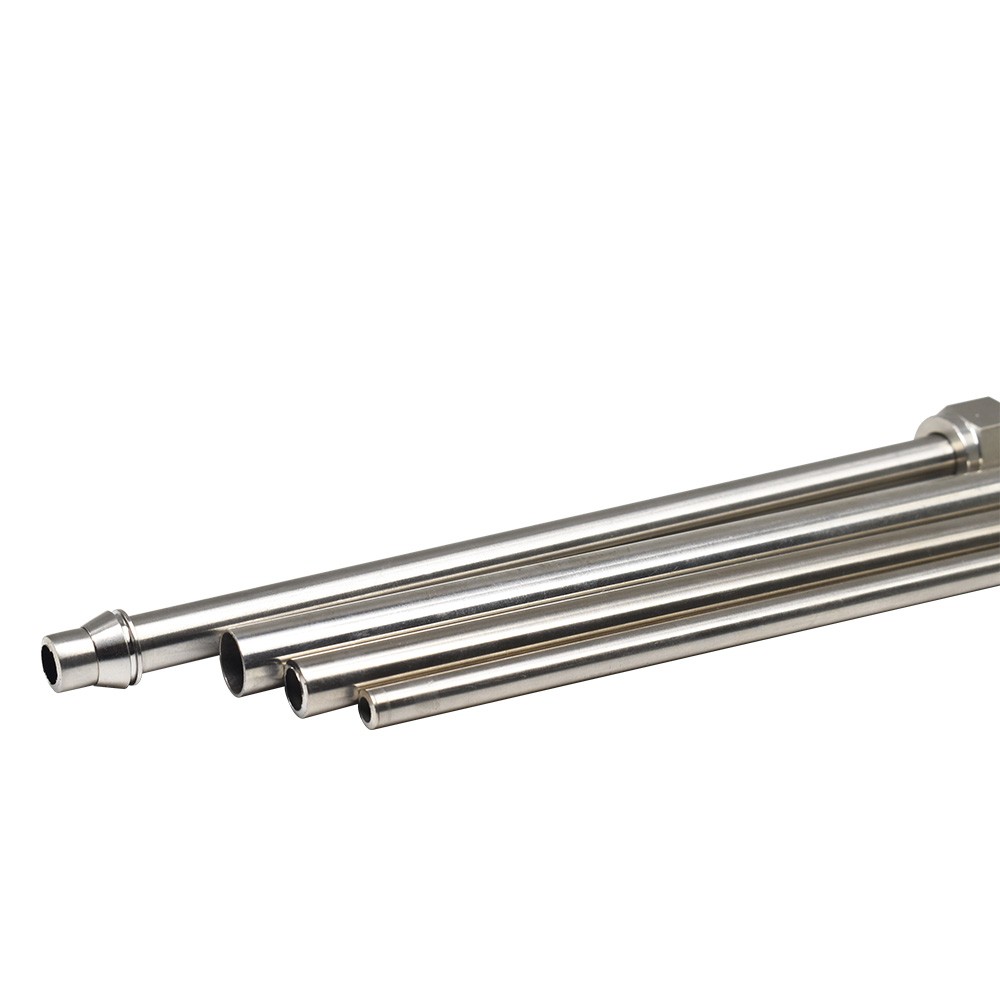
IntroductionIn industrial fluid systems, pipeline connection is the core link to ensure the safe operation of the system. As a mechanical connection method that requires no welding and can be repeatedly disassembled and assembled, the double ferrule tube fitting is widely used in petrochemical, semiconductor manufacturing, aerospace, and other fields due to its excellent sealing performance and vibration resistance. Its sealing reliability is not determined by a single factor, but is the result of the combined action of precise structural design, high-quality tubing selection, and advanced manufacturing processes. This article will deeply analyze the core logic of achieving reliable sealing from three dimensions: the structural principle of the double ferrule fitting, tubing adaptability, and the synergistic mechanism.
I. Structural Innovation of Double Ferrule Fittings: Synergy of Dual Sealing and Mechanical Locking
The core design breakthrough of the double ferrule fitting lies in the use of a front and back double ferrule structure, which achieves the dual functions of sealing and locking through mechanical deformation. This design solves the pain points of traditional single ferrule fittings, such as susceptibility to leakage and poor vibration resistance. Its sealing mechanism can be divided into three stages:
1.1 Initial Sealing: Plastic Deformation of the Front Ferrule
When the nut is tightened, the back ferrule is pushed forward under the axial force, driving the front ferrule to contact the tapered surface of the fitting body. The front ferrule undergoes plastic deformation under the extrusion of the tapered surface, its inner diameter gradually shrinks and embeds into the outer wall of the tubing, forming the first metal-to-metal seal line. The key to this process lies in:
Edge angle control: The edge angle of the front ferrule is strictly designed as 24°±0.5° according to the ISO 8434-1 standard, ensuring that the cutting depth is precisely controlled between 0.02-0.05mm, which not only forms sufficient contact stress (≥200MPa) but also avoids excessive cutting that damages the tubing.
Material compatibility: The front ferrule usually uses 316 stainless steel or high-carbon alloy steel, and its hardness (HV 300-400) is higher than that of the tubing (HV 150-200), ensuring that it dominates the formation of the sealing surface during the deformation process.
1.2 Secondary Sealing: Mechanical Support of the Back Ferrule
As the nut is further tightened, the back ferrule applies additional pressure to the front ferrule under the axial force, forcing its rear end to lift up and form a second seal with the tapered surface of the fitting body. At this time, the back ferrule itself also undergoes elastic deformation, and its front edge embeds into the outer wall of the tubing, forming a mechanical locking structure. The ingenuity of this design is:
Double wave deformation: The front ferrule produces a double wave plastic deformation under the combined action of the front and back ferrules. The first wave forms a seal, and the second wave provides anti-vibration support. Experimental data shows that this structure can increase the anti-vibration frequency of the fitting to over 200Hz, far exceeding the 50Hz of a single ferrule fitting.
Stress dispersion mechanism: The back ferrule converts the axial force into a radial clamping force through a lug structure, distributing the stress evenly on the circumference of the tubing, avoiding the risk of leakage caused by local stress concentration.
1.3 Torque Control: Guarantee of Precise Installation
The sealing performance of the double ferrule fitting highly depends on the precise control of the installation torque. Taking the Parker A-LOK fitting as an example, its standard installation process requires:
Initial pre-tightening: Finger-tighten the nut until it contacts the fitting body;
Marking and positioning: Make a mark at the 6 o'clock position of the nut;
Final tightening: Use a wrench to rotate the nut 1¼ turns (540°), moving the mark to the 9 o'clock position.
In this process, the advancing distance of the nut is precisely controlled at 1.52mm (1/16 inch) to ensure that the deformation of the ferrule is in the optimal range. Insufficient torque may lead to a loose seal; excessive torque may cause excessive deformation of the ferrule or crushing of the tubing.


II. Tubing Adaptability: The Material Basis of Sealing Performance
The sealing reliability of the double ferrule fitting depends not only on its own structure but is also closely related to the physical characteristics of the tubing. From tubing material, surface quality to dimensional accuracy, every parameter must strictly match the fitting design.
2.1 Material Hardness Matching: Avoiding "Hard on Hard" Damage
The hardness difference between the ferrule and the tubing is the key to ensuring the formation of a seal. If the tubing hardness is too high (such as certain alloy steel tubes), it may cause the front ferrule to be unable to cut in or the cutting depth to be insufficient, forming a leakage channel; if the tubing hardness is too low (such as annealed copper tubes), excessive plastic deformation may occur under the extrusion of the ferrule, resulting in insufficient springback of the sealing surface. Typical matching schemes include:
Stainless steel system: 316L ferrule with 316 seamless steel tube, hardness difference HV 100-150;
Carbon steel system: 20# carbon steel ferrule with 20# precision drawn steel tube, hardness difference HV 50-100;
Special working conditions: Alloy 625 ferrule with Alloy 625 tube, used in highly corrosive environments.
2.2 Surface Quality Requirements: Zero Tolerance for Micro-Defects
The surface quality of the tubing directly affects the sealing reliability. Any scratches, pits, or burrs can become a starting point for leakage. Industry standards require:
Surface roughness: Ra≤0.8μm, and there must be no longitudinal scratches exceeding the length of the ferrule;
Cleanliness: Free of oil, scale, or metal particles to avoid contaminating the sealing surface;
End treatment: Chamfering (C=0.5-1.0mm) and deburring are required to ensure smooth insertion into the bottom of the fitting.
2.3 Dimensional Accuracy Control: Strict Definition of Tolerance Zones
The outer diameter tolerance of the tubing is the core parameter affecting sealing performance. If the tolerance is too large, it may cause the ferrule to fail to contact both the tubing and the fitting body simultaneously, forming a leakage gap. Taking a Φ6mm tube as an example:
Standard tolerance: ±0.05mm (ordinary grade);
High-precision tolerance: ±0.02mm (used in the semiconductor industry);
Consequences of out-of-tolerance: An oversized outer diameter may prevent the ferrule from being fully inserted; an undersized outer diameter may lead to a loose seal.
III. Synergy Between Structure and Tubing: Overall Optimization of the Sealing System
The reliable sealing of the double ferrule fitting is not a simple superposition of structure and tubing, but the deep synergy of the two achieved through precise design. This synergy is reflected in the following three levels:
3.1 Deformation Compensation Mechanism: Dealing with Tubing Manufacturing Deviations
Even if there are slight deviations in the dimensions of the tubing, the double ferrule structure can still achieve sealing compensation through elastic deformation. For example:
Oversized outer diameter: The back ferrule produces greater elastic deformation during the advancing process to absorb the excess size;
Undersized outer diameter: The front ferrule cuts deeper into the tubing under the extrusion of the tapered surface, ensuring the sealing contact area;
Ovality: The radial clamping force of the double ferrule can automatically correct the roundness of the tubing, eliminating eccentric leakage.
3.2 Stress Distribution Optimization: Extending Seal Life
The stress of a traditional single ferrule fitting is concentrated near the edge, which easily leads to fatigue cracks. The double ferrule structure optimizes stress distribution in the following ways:
Front ferrule: Bears the main sealing function, and its stress gradually decays with the depth of deformation;
Back ferrule: Provides uniform clamping force, converting axial stress into radial distribution;
Tubing: Produces a double wave deformation under the action of the double ferrule, reducing the peak stress by more than 50%.
3.3 Enhanced Environmental Adaptability: Wide Temperature Range Sealing from -196°C to 648°C
Through the combination of material selection and structural design, the double ferrule fitting can adapt to extreme working conditions:
Low-temperature environment: Uses a 316L stainless steel ferrule, whose ductile-brittle transition temperature is lower than -196°C, avoiding cold brittle leakage;
High-temperature environment: Selects an Alloy 625 ferrule, which still maintains sufficient strength and elasticity at 648°C;
Corrosive media: The C-276 alloy ferrule can withstand 98% concentration of sulfuric acid without the risk of pitting on the sealing surface.

IV. Industry Application Cases: Practical Verification of Sealing Reliability
4.1 Semiconductor Manufacturing: Ultra-Pure Gas Delivery Systems
In chip manufacturing, the delivery of specialty gases such as nitrogen trifluoride (NF₃) requires a leakage rate of ≤1×10⁻⁹ atm·cc/s. A semiconductor company used double ferrule fittings to connect Φ3mm PFA tubing, achieving the goal through the following measures:
Ferrule design: The edge angle of the front ferrule was optimized to 22° to reduce gas molecule penetration;
Tubing treatment: Electrolytic polishing was adopted, with surface roughness Ra≤0.2μm;
Installation control: Torque-limiting wrenches were used to ensure the installation torque deviation of each fitting was ≤5%.
After 3 years of system operation, no out-of-standard points were found in leak detection, verifying the reliability of the double ferrule fitting in ultra-pure environments.
4.2 Aerospace: Fuel Delivery Pipelines
The fuel pipeline of a certain type of rocket uses double ferrule fittings to connect Φ10mm 321 stainless steel tubing, which needs to withstand a -180°C liquid oxygen environment and 60MPa pressure. Solutions include:
Ferrule material: 321 stainless steel with excellent low-temperature toughness was selected and subjected to cryogenic treatment (-196°C×24h);
Tubing preparation: A cold drawing + annealing process was adopted to ensure the tubing grain size is ≤ grade 7;
Structural improvement: An elastic support ring was added to the back ferrule to compensate for stress relaxation caused by low-temperature shrinkage.
Ground tests showed that the fitting maintained zero leakage after 100 thermal cycles, meeting aerospace-grade reliability requirements.
V. Future Trends: Intelligence and Material Innovation Drive Sealing Upgrades
With the development of Industry 4.0, the sealing technology of double ferrule fittings is evolving towards intelligence and high performance:
Intelligent installation systems: Integrating torque sensors and laser positioning devices to achieve real-time monitoring and data traceability of the installation process;
Nano-coating technology: Depositing DLC (Diamond-Like Carbon) coatings on the sealing surface of the ferrule, reducing the friction coefficient to 0.05 and extending the service life by 3 times;
Composite material applications: Developing carbon fiber-reinforced ferrules, reducing weight by 40% while maintaining sealing performance, suitable for the aerospace field.
Conclusion
The reliable sealing of the double ferrule fitting is a culmination of structural engineering, materials science, and precision manufacturing. Through the deformation synergy of the double ferrule, the precise adaptation of the tubing, and the deep interaction between the two, it builds a multiple defense line against pressure, temperature, and corrosion. In the future, with the integration of new materials and smart technologies, the double ferrule fitting will undoubtedly continue to safeguard the safe operation of industrial fluid systems with higher reliability and broader adaptability.