In industrial automation and process control systems, stainless steel three-valve manifolds play a critical role in ensuring accurate pressure measurement and system safety. Widely used in sectors such as petrochemical, power generation, pharmaceuticals, and food processing, these components serve as essential interfaces between differential pressure transmitters and process pipelines. This guide provides a detailed overview of their installation procedures, product characteristics, operating principles, maintenance strategies, and critical safety considerations.
1. Installation Steps for Stainless Steel Three-Valve Manifolds
Proper installation is fundamental to the reliable operation of three-valve manifolds. Follow these structured steps to ensure optimal performance:
1.1 Pre-Installation Preparation
Component Inspection:
Check for cracks, sand inclusions, or surface defects on the valve body.
Verify smooth operation of the valve stem without sticking.
Ensure sealing surfaces are free from scratches or burrs.
Cleaning:
Use oil-free compressed air to blow out debris from the valve cavity.
For welded connections, perform degreasing to prevent carbonization during high-temperature operation.
Environmental Assessment:
Avoid installing near vibration sources (e.g., pump outlets), heat sources (e.g., steam lines), or strong electromagnetic fields.
Example: A power plant experienced ±5% measurement fluctuations after installing a manifold near a turbine vibration platform.
1.2 Mounting Orientation
Operational Space:
Ensure ≥150 mm clearance around handwheels/levers for emergency operation.
A marine platform faced a 4-hour shutdown due to restricted access during maintenance.
Flow Direction:
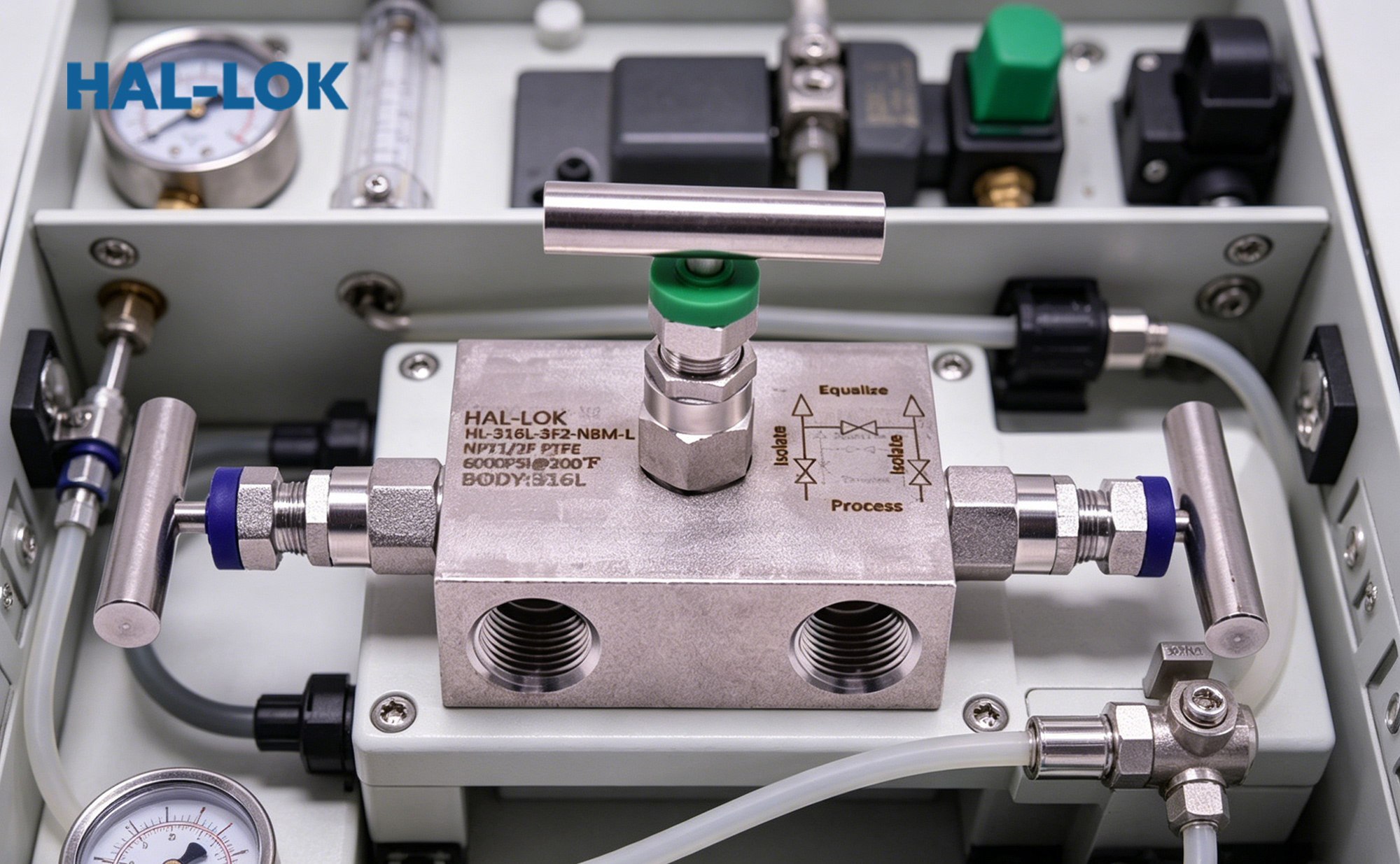
Strictly follow "H" (High Pressure), "L" (Low Pressure), and "EQ" (Equalize) markings.
A refinery incurred a $20,000 loss after reverse flow damaged a transmitter diaphragm.
Gravity Considerations:
For media with solid particles, install with a "low-in, high-out" orientation to prevent sedimentation.
1.3 Connection Methods
Threaded Connections:
Wrap PTFE tape in the same direction as thread rotation (3–5 layers).
A food plant experienced contamination due to incorrect wrapping direction.
Flange Connections:
Use a diagonal tightening sequence with ≤5% torque variation.
A chemical plant faced a gasket failure from uneven bolt tension.
Welded Connections:
For DN ≥25 pipes, combine TIG welding (root pass) with MMA welding (cover pass).
Maintain 1–2 mm weld reinforcement height.
1.4 Transmitter Integration
Coplanar Flange Alignment:
Use定位 pins (alignment pins) for Rosemount 3051 series transmitters.
Tighten bolts to 40–50 N·m torque.
A steel mill recorded a 3% measurement error from misalignment.
Impulse Line Layout:
Keep lines between 3–6 m long with a ≥1:12 slope for condensate drainage.
1.5 Pre-Commissioning Checks
Leak Testing:
Combine visual inspection with soap solution testing at valve stem seals and flange joints.
Functional Testing:
Follow the sequence: Open EQ → Open H → Close EQ → Open L.
Monitor transmitter output for smooth transitions.
2. Key Product Characteristics
2.1 Material Excellence
Valve Body:
316L stainless steel with ≥2.5% molybdenum content offers 3× better pitting resistance than 304 SS in chloride environments.
Example: A marine platform reported zero corrosion after 5 years of seawater exposure.
Sealing Materials:
PTFE (-54°C to 232°C) for general applications.
Graphite (up to 550°C) for high-temperature steam systems.
2.2 Structural Innovations
Monolithic Design:
Eliminates middle flange leakage points, reducing leaks by 80% compared to split-body designs.
Angled Balance Valve:
Reduces operating torque by 30%, enabling single-handed glove operation.
2.3 Performance Specifications
Pressure Ratings:
PN1.6 to PN42 MPa, supporting applications from atmospheric to supercritical conditions.
Temperature Range:
-196°C (LNG) to 550°C (ultra-supercritical steam).
3. Operating Principles
3.1 Normal Measurement Mode
With EQ closed and H/L valves open, media flows into the transmitter’s positive/negative pressure chambers, generating a differential signal. Pressure drop ≤0.01 MPa.
3.2 Zero Calibration Mode
Open EQ → Close H/L valves to equalize pressure for non-stop zeroing. A chemical plant reduced annual calibration time from 72 to 8 hours using this method.
3.3 Maintenance Isolation Mode
Close H/L valves to safely disconnect the transmitter for servicing. Maintenance time decreased from 4 to 0.5 hours per incident at a refinery.
4. Maintenance & Management Strategies
4.1 Routine Inspections
Daily Checks:
Monitor temperature, vibration, and leaks using infrared thermometry.
Data Logging:
Track transmitter outputs to detect valve wear via trend analysis.
4.2 Preventive Maintenance
Packing Replacement:
Every 2 years (1 year for corrosive media). A plant reduced stem leakage from 5% to 0.2% through timely replacements.
Drainage:
Weekly purging of condensate to prevent particle buildup.
4.3 Predictive Maintenance
Ultrasonic Testing:
Annual wall thickness measurements to identify corrosion.
Actuation Testing:
Quarterly full-stroke tests to ensure valve mobility.
5. Critical Safety Precautions
No Pressurized Disassembly: A technician suffered second-degree burns after removing a pressurized valve.
Symmetrical Tightening: A pipeline explosion occurred due to asymmetric flange bolting.
Media Compatibility: A sugar plant faced blockages from unpurged crystallized syrup.
Pressure Rating Matching: A valve burst after using a PN16 manifold with a PN25 transmitter.
Particle Filtration: A cement plant accelerated valve wear by 3× due to missing filters.
Welding Protection: A logistics company caused hidden cracks via uncooled welding.
Mechanical Protection: A油田 (oilfield) experienced valve damage from rough handling during transport.
Torque Verification: A chemical plant reduced fire risks by validating bolt tension every 2 years.
Static Grounding: A gas explosion resulted from ungrounded valves in explosive zones.
Maintenance Records: A company optimized spare parts inventory by 30% through data analysis.
Stainless steel three-valve manifolds are indispensable for reliable pressure measurement in industrial systems. By adhering to standardized installation practices, leveraging their material and design advantages, understanding their operating principles, implementing proactive maintenance, and following strict safety protocols, operators can maximize system uptime and safety. As industries embrace Industry 4.0, intelligent monitoring technologies are further enhancing the predictive capabilities of these manifolds, paving the way for smarter, safer, and more efficient industrial operations.
Stay vigilant, stay safe, and optimize performance with every valve operation!