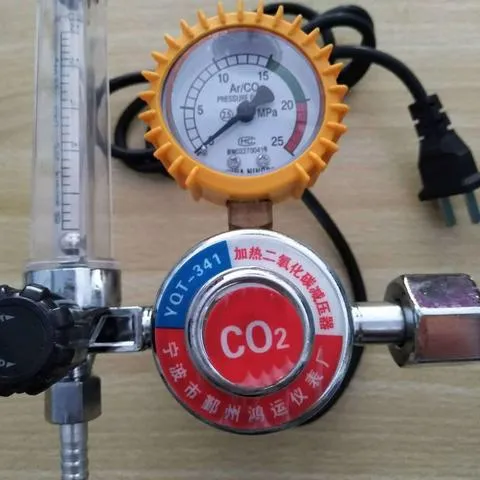

Carbon Dioxide (CO2) is a cornerstone of modern industry, but releasing it from high-pressure storage triggers a severe cooling effect. This can freeze equipment, halt production, and create safety risks. This report explores why a simple heater is not just an accessory, but a critical component for ensuring both industrial safety and operational efficiency in any CO2 gas delivery system.
I. The Chilling Effect: Heat Loss During Pressure Reduction
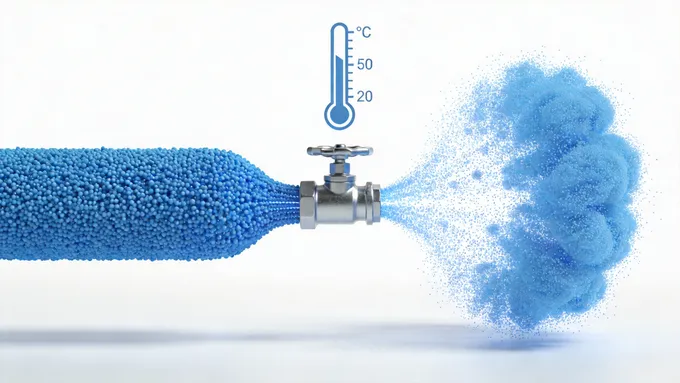
The intense cooling during CO2 decompression is driven by two powerful physical phenomena: the Latent Heat of Vaporization and the Joule-Thomson Effect. As liquid CO2 in a cylinder boils to replace the escaping gas, it absorbs a massive amount of energy from its surroundings. Simultaneously, as the high-pressure gas expands through the regulator's narrow orifice, it undergoes a rapid temperature drop due to the work done against intermolecular forces.
Vaporizing liquid CO2 absorbs a large amount of vaporization heat (approximately 574kJ/kg). During throttling expansion, the gas temperature may plummet by 40-60°C.
II. The Icy Consequences: Core Problems Caused by Low Temperatures
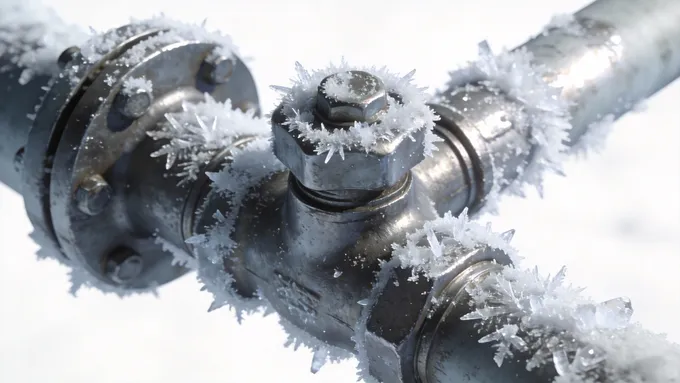
The visible frost is just the beginning. This "cold shock" initiates a cascade of failures:
Equipment Freezing & Blockage: Atmospheric moisture freezes on the regulator, forming an ice block that prevents adjustments. More critically, internal ice crystals can restrict or completely block gas flow, leading to pressure instability and potential damage to downstream equipment upon melting.
Material Performance Degradation: Elastomer seals (like NBR or PTFE) become hard and brittle at low temperatures. A hardened seal cannot conform to the valve seat, increasing leakage rates by over 30% and creating a significant safety hazard.
Process Parameter Instability: In processes like Gas Metal Arc Welding (GMAW), cold CO2 is denser and causes arc instability and spatter. Consistent, stable gas temperature is crucial for achieving high-quality results.
III. The Warm-Up: How Heaters Solve the Problem
The solution is active thermal compensation via electric heaters. These devices use resistance elements to convert electrical energy into thermal energy, typically positioned just before the pressure reduction stage. The goal is not to make the gas "hot," but to maintain its temperature above freezing ( >0°C) or at a stable process temperature (~20°C). In advanced applications like supercritical CO2 power cycles, multi-stage heating is integral to the system, boosting thermal efficiency by up to 15%–22%.
IV. Heaters in Action: Real-World Engineering Practices
Heaters are applied across various industries to ensure reliability and quality:
Precision Welding: PID-controlled heaters eliminate regulator freezing, stabilize the arc, and reduce weld porosity defects by 25%, significantly cutting down on rework.
High-Tech Agriculture: In greenhouses, integrated burner-heater systems generate CO2 and deliver it at a plant-friendly 35-40°C, boosting photosynthesis without shocking the crops.
Chemical Production Lines: Electric tracing heating along pipelines maintains CO2 at the optimal reaction temperature, ensuring uniform product quality regardless of ambient conditions.

Conclusion
The humble heater on a CO2 regulator is a critical shield, embodying the intersection of thermodynamics, material science, and industrial safety. By neutralizing the severe cooling effects of decompression, these devices prevent equipment failure, enhance seal longevity, and guarantee process integrity. As industries advance towards greater precision and CO2 becomes more central to green energy, the technology of these thermal guardians will only become more integrated and intelligent.