Search for more information
In industrial gas transportation, laboratory precision gas supply, and medical equipment applications, stainless steel dual-gauge pressure regulators have become core components ensuring stable system operation. Their unique dual-gauge design, high-precision pressure regulation capabilities, and reliable safety performance deliver comprehensive support for industrial production and scientific research. Their core value lies not only in precise gas pressure control but also in real-time dual-gauge monitoring, corrosion-resistant materials, and multiple protective mechanisms.
I. Dual-Gauge Real-Time Monitoring: Pressure Changes at a Glance
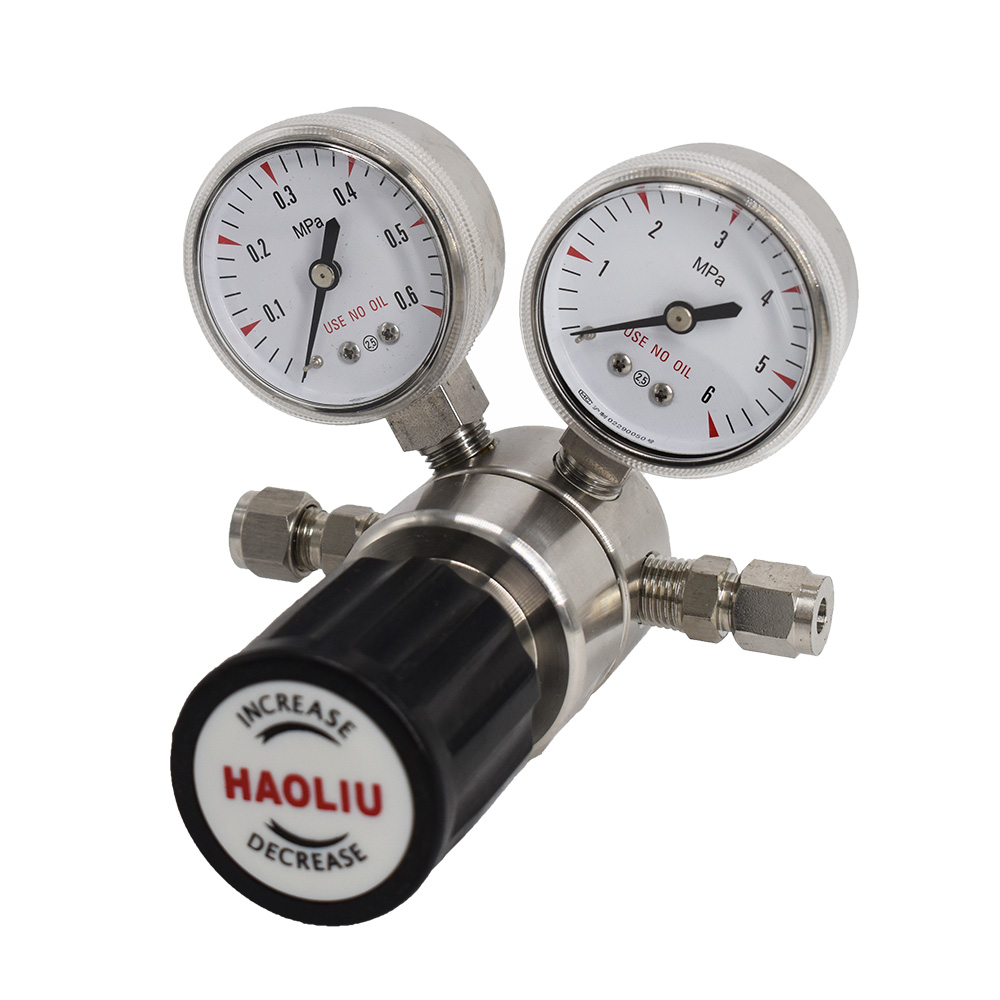
The core innovation of stainless steel dual-gauge pressure regulators lies in their high-pressure and low-pressure gauges, which respectively display the original cylinder pressure and the reduced output pressure. For instance, in industrial gas supply systems, the high-pressure gauge provides real-time visibility into remaining cylinder gas volume, preventing process interruptions due to insufficient pressure. while the low-pressure gauge ensures output pressure remains stable within process requirements. In laboratory high-purity gas analysis, for instance, precise pressure control between 0.1-0.5MPa is essential. The dual-gauge design allows operators to simultaneously monitor upstream and downstream pressures, enabling rapid system status assessment. This feature is particularly critical in medical oxygen supply scenarios: when the high-pressure gauge indicates cylinder pressure drops below 1MPa, operators can proactively replace the cylinder, preventing treatment disruptions due to insufficient pressure.
II. High-Precision Pressure Regulation: Meeting Demanding Process Requirements
Through a two-stage pressure reduction structure, the stainless steel dual-gauge pressure regulator achieves dual-control pressure adjustment: coarse adjustment followed by fine adjustment. Taking the CGA330 regulator as an example, its primary stage valve initially reduces high-pressure gas to intermediate pressure (e.g., 5 MPa). The secondary stage valve then employs a diaphragm-type regulating mechanism to precisely adjust the pressure to the user-required range of 0-1 MPa, with an adjustment accuracy of ±0.01 MPa. This design offers significant advantages in high-precision fields like semiconductor manufacturing. For instance, in etching processes where gas pressure fluctuations must be controlled within 0.001MPa, the two-stage structure effectively minimizes pressure variations through phased reduction, ensuring process stability.
III. Corrosion-Resistant Materials: Adapting to Harsh Conditions
Constructed primarily from 316L stainless steel, the regulator exhibits outstanding corrosion resistance and high-temperature tolerance. In chemical production, when conveying corrosive gases like chlorine or hydrogen sulfide, ordinary carbon steel pressure reducers are prone to leakage due to corrosion. In contrast, 316L stainless steel resists erosion from most acidic and alkaline media, extending equipment lifespan to over 10 years. Additionally, in high-temperature environments (e.g., metallurgy), the stainless steel material withstands temperatures exceeding 200°C, preventing seal failure caused by material deformation.
IV. Multi-Layered Safety Protection: Fortifying Risk Defenses
Safety valves and built-in filters form a dual-protection system. When output pressure exceeds set values (e.g., 1.3 times rated pressure), safety valves automatically vent to prevent pipeline or equipment damage from overpressure. Filters with 5-10μm precision intercept particulate impurities in gases, preventing wear on precision components like valve cores and diaphragms. For instance, in food-grade CO₂ supply systems, the filter prevents pipeline rust particles from contaminating gas, ensuring products meet sanitary standards.
V. Application Scenarios: From Laboratories to Industrial Sites
Stainless steel dual-gauge pressure regulators serve diverse fields: In industrial automation, they deliver stable pressure to pneumatic valves and robotic air supply systems; In healthcare, its high-precision pressure regulation ensures safe operation of ventilators and anesthesia machines; in laboratories, the dual-gauge design allows researchers to simultaneously monitor cylinder levels and experimental pressures, enhancing efficiency. For instance, a university chemistry lab reduced gas waste by 30% and significantly improved experimental reproducibility after adopting dual-gauge regulators.
The stainless steel dual-gauge pressure regulator has become a benchmark product in industrial gas control through its dual-gauge monitoring, two-stage pressure regulation, corrosion-resistant materials, and safety protection features. It not only enhances system stability and safety but also provides critical support for high-end manufacturing, scientific innovation, and healthcare through precise pressure management. With the advancement of Industry 4.0 and smart manufacturing, the stainless steel dual-gauge pressure regulator will continue to evolve, empowering industrial upgrades with higher precision and smarter functionality.