Search for more information
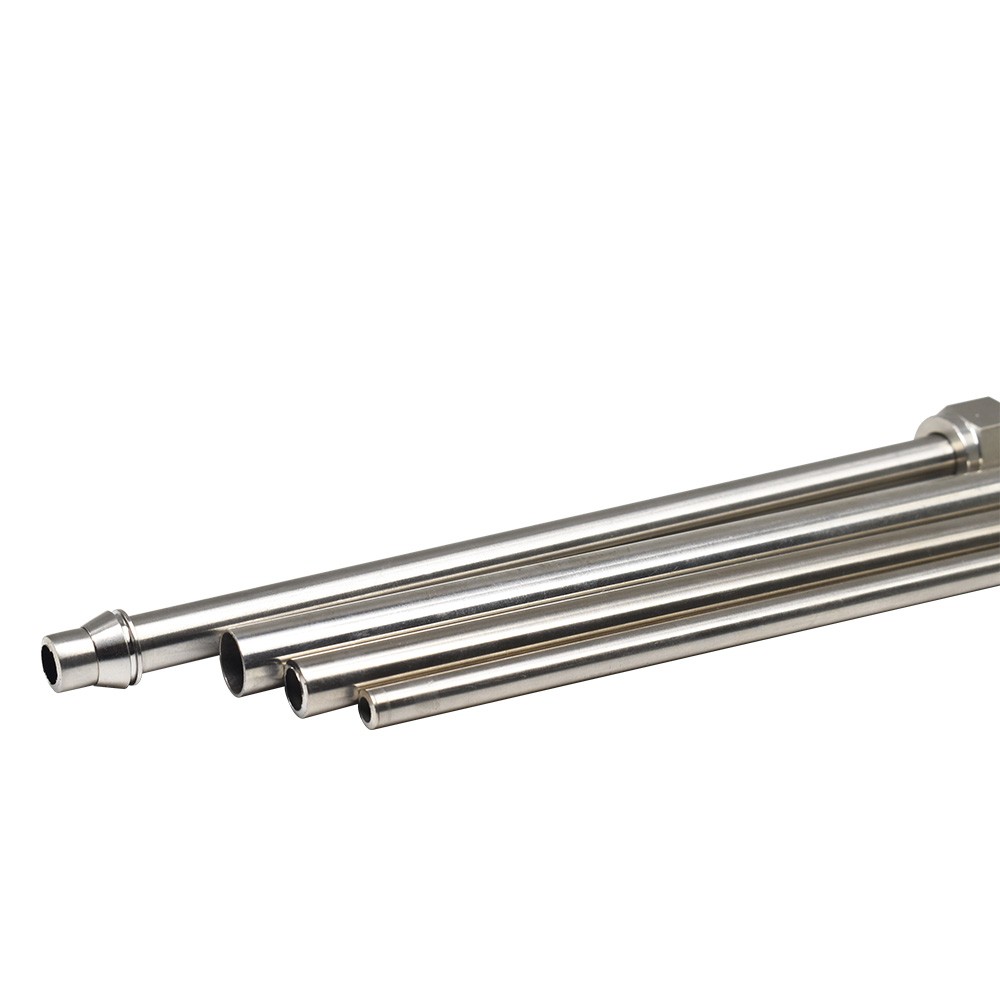
In industrial sectors such as petrochemicals, food and pharmaceuticals, and power generation, the safety and reliability of piping systems directly determine production efficiency and product quality. As a core component in pipeline connections, stainless steel ferrule straight fittings have become the “joint hubs” of modern industrial piping systems due to their unique structural design, outstanding performance parameters, and broad adaptability across scenarios. This article systematically analyzes the core value of this precision component from three dimensions: technical characteristics, application scenarios, and installation specifications.
Stainless steel ferrule straight fittings utilize medical-grade stainless steel materials like 304/316L, featuring chromium content ≥18% and nickel content ≥8%. These materials form a dense oxide film in oxidizing media, resisting corrosion from substances like chloride ions and sulfides.
For instance, on a marine oil platform, 316L ferrule fittings operated continuously for five years in a salt-fog marine environment without corrosion, reducing maintenance costs by 6 million yuan.
Their tensile strength exceeds 520 MPa, withstanding 63 MPa high pressure—far surpassing the pressure tolerance of ordinary carbon steel fittings.
The fitting employs a double ferrule structure, achieving triple sealing through mechanical interlocking:
Radial Sealing: The outer ferrule's cutting edge penetrates the pipe wall, eliminating gaps between the pipe and fitting.
Axial Sealing: The tapered surface at the inner ferrule's tail forms a line contact seal with the tapered bore inside the fitting body.
Elastic Compensation: The arched design in the middle of the ferrules provides axial elastic deformation, absorbing stresses from vibration and thermal expansion/contraction.
Field test data from a refinery shows this structure maintains a leakage detection accuracy of 0.1 ml/min at 450°C, with a false alarm rate below 0.1%.
The joint body, ferrule, and nut are independently designed, enabling quick on-site specification changes.
At a power plant, upgrading water pipeline diameter from DN50 to DN80 by replacing the ferrule assembly reduced the retrofit cycle from 30 days (traditional welding) to 7 days.
All components support over 50 cycles of disassembly/reassembly with seal performance degradation <5% per cycle.
Deep-sea Oil & Gas Extraction: In ultra-low temperatures of -196°C (-320°F), titanium alloy ferrule fittings withstand 3,000-meter water pressure, eliminating cold brittleness fractures common in traditional welded joints.
Supercritical Fluid Transfer: Duplex stainless steel ferrules extend the upper operating temperature limit to 600°C, enabling adaptation to novel processes like carbon dioxide enhanced oil recovery.
Space Life Support Systems: Lightweight design (20% lighter than traditional fittings) meets spacecraft weight reduction requirements. Implementation in a space station's oxygen pipeline achieved 10 years of maintenance-free operation.
Food & Pharmaceutical Industry: Joint surface roughness Ra ≤ 0.4μm, certified for CIP/SIP online cleaning to prevent microbial growth. A vaccine production line achieved 99.99% product yield after adoption.
Semiconductor Manufacturing: Electropolished ferrule joints in ultrapure water systems deliver metal ion leaching < 0.01ppb, meeting 7nm chip fabrication standards.
Flammable/Explosive Environments: Spark-free cold connection eliminates ignition risks. After implementation in a chemical park's hydrogen pipeline, explosion incidents decreased by 80%.
Highly Corrosive Media: Hastelloy ferrules withstand 98% concentrated sulfuric acid, enabling long-term stable operation in hydrometallurgical processes.
Pipe Preparation: Cut seamless steel pipes using dedicated pipe cutters. Deburred ends must meet:
Face perpendicularity ≤0.5°
Surface roughness Ra ≤3.2μm
Straight section length at bends ≥3 times nut length
Component Inspection: Verify ferrule edges are undamaged, nut threads are intact, and internal tapered holes in fittings meet NAS 7 cleanliness grade.
Lubrication: Apply specialized molybdenum disulfide grease to the outer surface of the ferrule and the tapered bore inside the fitting body to reduce the friction coefficient below 0.1.
Pre-assembly:
Sequentially insert the nut and ferrule onto the pipe.
Insert the pipe into the fitting body until bottomed out.
Manually tighten the nut to the pressure point (torque surge point).
Continue tightening 1/2 turn with a torque wrench (Recommended torque for 304 stainless steel pipe: 45 N·m for DN15 pipe).
Seal Testing: Conduct spot checks using a helium mass spectrometer leak detector. Leak rate must be <1×10⁻⁹ Pa·m³/s.
Functional Verification: Perform a hydrostatic test at 1.5 times working pressure. Maintain pressure for 30 minutes with no pressure drop.
Documentation: Establish installation records documenting critical parameters including torque values and leak detection data.
With the advancement of Industry 4.0, smart ferrule fittings have entered practical application:
Self-Diagnostic Capability: Integrated piezoelectric sensors monitor sealing pressure in real-time and upload data to the cloud. Third-generation products developed by a research institute can provide 72-hour advance warning of leakage risks.
Green Manufacturing: Powder metallurgy processes boost material utilization to 95%, reducing per-joint carbon emissions by 15% compared to traditional methods.
Extreme Environment Adaptation: Nanocoating technology enables operation at 1000°C, providing connection solutions for nuclear fusion devices.
Through the deep integration of materials science, precision manufacturing, and intelligent technology, stainless steel ferrule straight fittings not only redefine technical standards for pipeline connections but also emerge as critical infrastructure driving industrial advancement. From deep-sea exploration to space missions, and from food processing to semiconductor manufacturing, these precision components ensure the safe operation of global industrial systems with their zero-leakage, high-reliability, and easy-maintenance characteristics.